
Othello
“What shall I say? Where’s satisfaction?”

“What shall I say? Where’s satisfaction?”
Iago says to Othello when he demands proof of Desdemona’s infidelity, not for her sake but his own. Othello wants to vanquish his doubt this way or that even as it is doubt he perpetuates with his constant demand. Readers of Othello have endlessly asked what the motivations of the villainous Iago are. Why does he weave treachery when he has little to gain, except money and rank, and eventually shame and death? Some have suggested he does it out of sadism, others show his love-hate relationship with Othello, yet others remark that he is a motiveless character, a perpetual mystery. As I rose in applause and awe from my seat at London’s Theatre Royal Haymarket two weeks ago, it was clear to me that Iago was a character only in disguise. I sought to confirm my suspicion by reading the play and while the page did not substitute for the performance, I said to myself yet again: Iago is but Othello’s voice. The voice of his internal doubt, quoted back to Iago by Othello, ““Think, my lord?” By heaven, thou echo’st me.”
When the curtain came down for the interval, I found the play too simple to be considered one of Shakespeare’s greatest. This one man, through his not so ingenious tricks, was wreaking havoc in everyone else. Othello’s love for Desdemona, professed unabashedly in front of the Duke just now, crumbles like a castle of cards in front of the audience’s eyes. A handkerchief dropped and found, a conversation overheard, a request misconstrued—this is all it takes for Othello to believe that Desdemona is unfaithful, that his once loyal lieutenant Cassio is sleeping with her. How could one man do all this, I asked myself? That too when his motives were far from clear. As the play progressed in the second half, Othello’s suspicion grew stronger with the scene, with Iago only adding fuel to the fire that had already been lit. It is in Othello’s speech that I found an answer:
Avaunt! Begone! Thou hast set me on the rack.
I swear ’tis better to be much abused
Than but to know ’t a little.
The “little” germ that has made its way into Othello’s spirit does all the work. It sees every misstep on Desdemona’s part as proof of her unfaithfulness. What we see unfold is not Iago’s villainy but the sheer crippling power of doubt. Once indulged, it does not leave easily. It troubles the man, awake and asleep, as a toothache, an itching wound, an unpleasant taste. It puts a veil so powerful on one’s eyes, ears, and brains that all past memory of faith and joy, of love and vows of lifelong trust are reduced to nought. While Shakespeare calls this “jealousy”, as in Othello’s jealousy towards Cassio, his opposite in colour and complexion, we may well read it as doubt:
They are not ever jealous for the cause,
But jealous for they’re jealous.
It is a monster Begot upon itself, born on itself.
We need no more than this. We doubt for we doubt, it is a monster begot upon itself, born on itself. A critic points out that Desdemona does little to rebut Othello’s charges of unfaithfulness, that she assumes a child-like innocence. This may have, methinks, less to do with Shakespeare’s attitude towards female characters than his understanding of the power that is doubt. Desdemona says “I never gave him the cause!” to which her wise and faithful maid Emilia replies “But jealous souls will not be answered so,” followed by the excerpt above. It matters little what Desdemona does, for Othello’s doubt has less to do with her acts than his own mind.
The mind is a strange, strange creature, the strangest of them all. It relishes doubt; it merries in its own refutation. This constant doubt may be productive, such as the radical doubt that founds all philosophy, but if it takes too strong a hold, it destroys all that come in its way. For even philosophy cannot be done but for a little faith. Thus, it is not at all surprising for me when at the play’s end, when Desdemona is killed and Emilia plays the swan, and when truth descends upon Othello, that Iago says:
Demand me nothing. What you know, you know.
From this time forth I never will speak word.
Having destroyed everything, Iago disappears, as if he never existed. He shows no remorse. Why should he? It was Othello’s own voice that Othello acted upon. That voice has met its answer, there is no more to be said, except his own fated death. At the end of the year, as I struggle to write, it is not so strange (is it?) that I turn to doubt. We are all ridden with doubt all the time. We doubt our loves and our hates, our dreams and our nightmares. Most of all, we doubt ourselves. And yet, it is Iago, that most foul villain, who reminds us:
’Tis in ourselves that we are thus or
thus. Our bodies are our gardens, to the which our
wills are gardeners.
Let us, in this new year, doubt a little less, and in ourselves and our wills, have a little more faith.
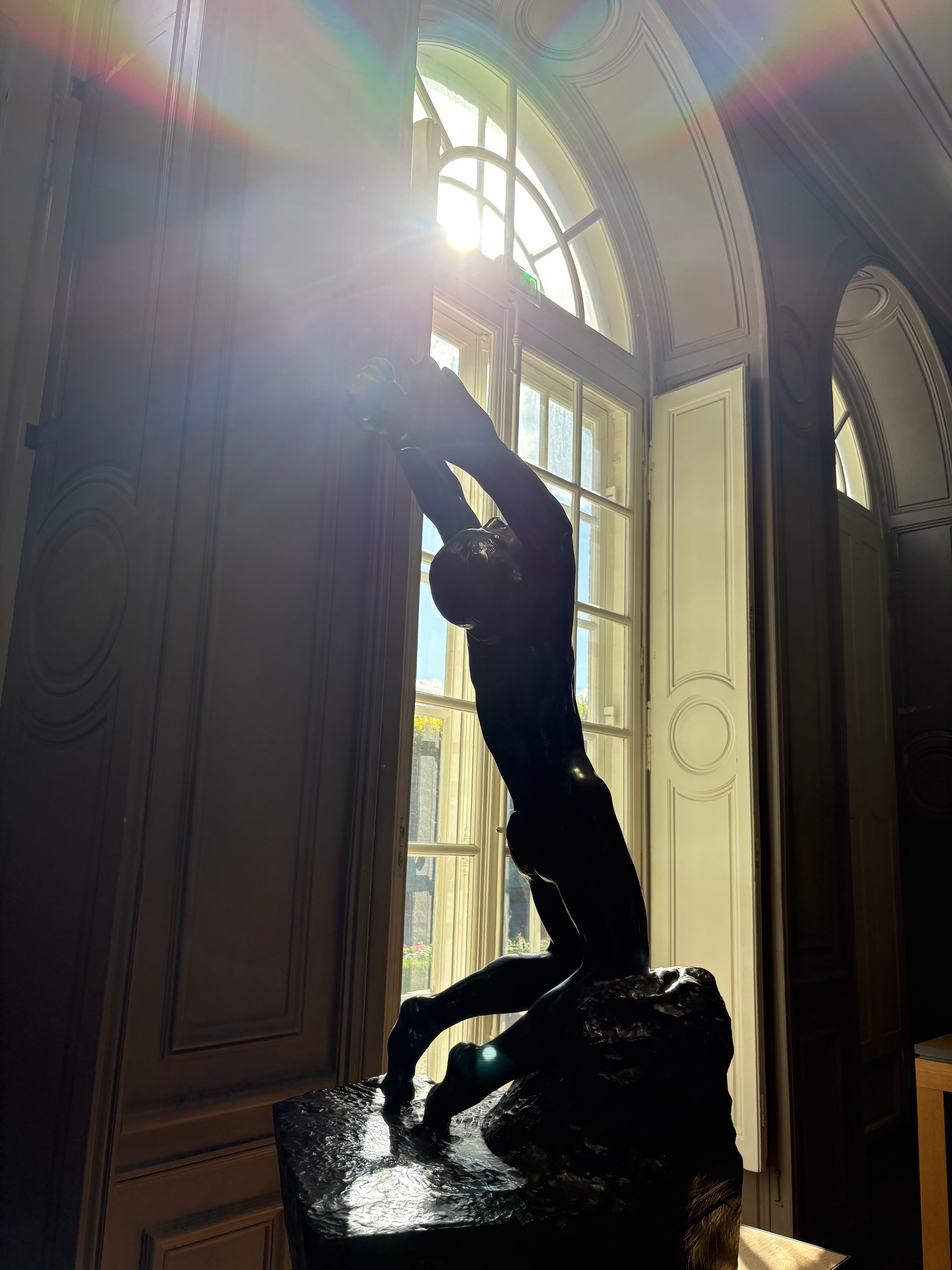
Feature Image: The Prodigal Son by Auguste Rodin. Musée Rodin, Paris. Photograph mine.